How does Striff know what my architecture is supposed to look like?
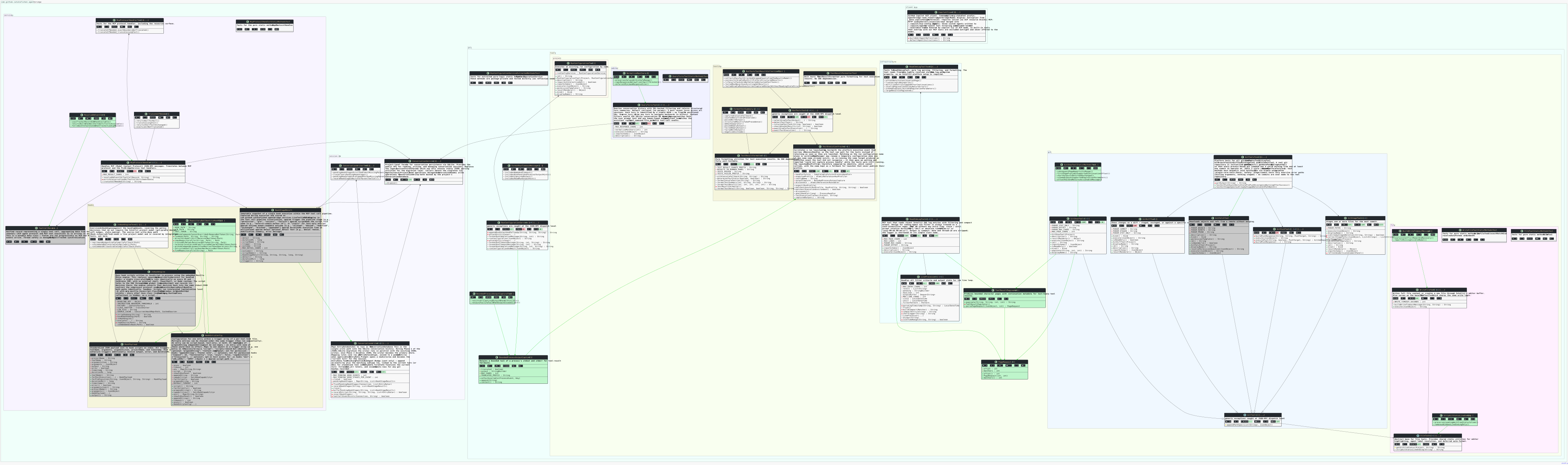
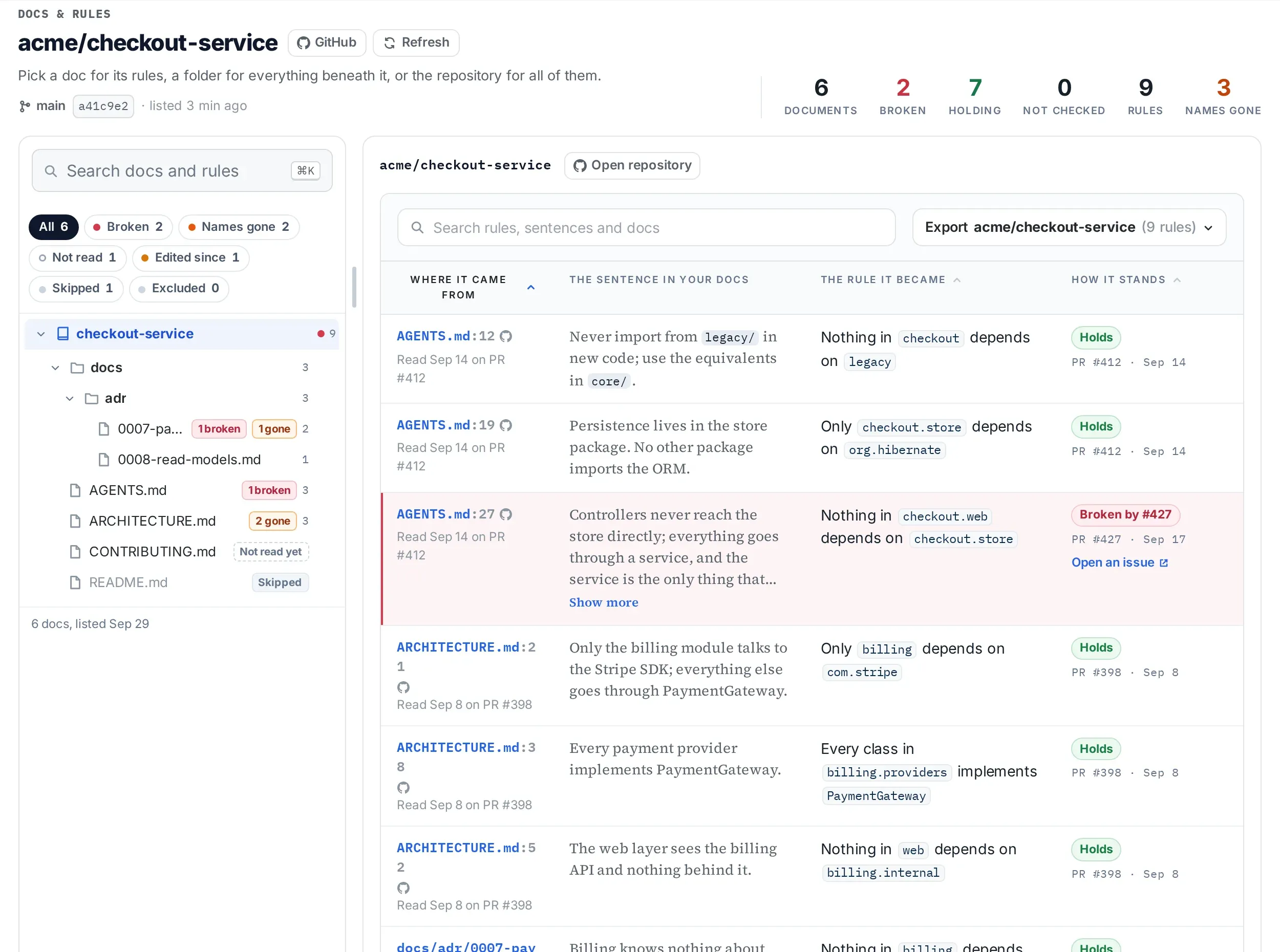
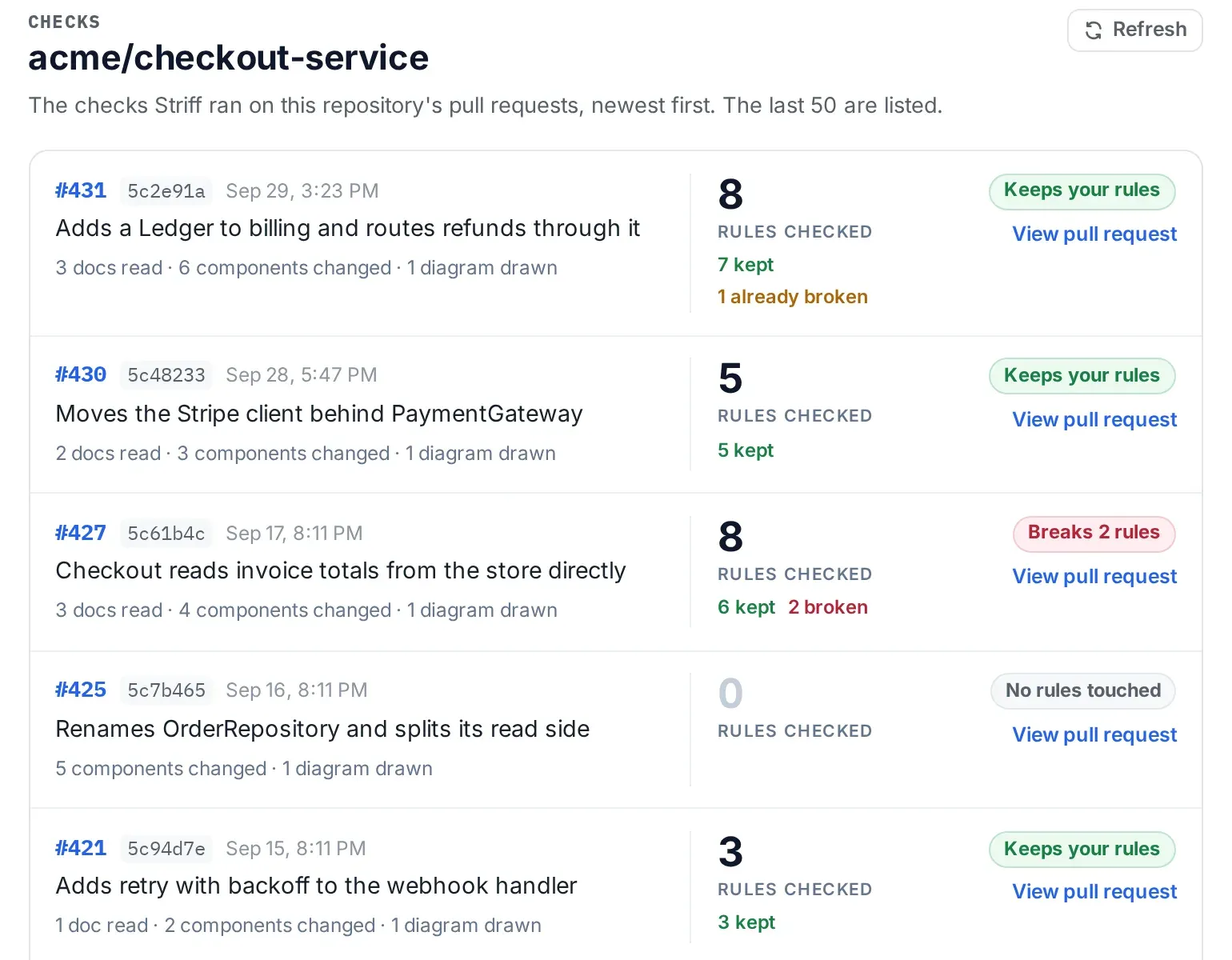
You already wrote it down. Striff reads the documents in your repository that make claims about the code, turns those sentences into rules, and checks them against the code your pull request produces, quoting the sentence and linking the file it came from. Nothing is configured and no rule format is invented: your documentation is the rulebook. A rule can be as plain as where a class lives or as sharp as “the domain module must not depend on infrastructure”. Alongside the rules, every pull request gets a diagram of what changed and review notes on the components it touched. If your docs make no checkable claim about the code, Striff invents no rules of its own: you still get the diagram and the review notes.
Does Striff work with spec-driven development?
Yes: it is the check that comes after the spec. Spec-driven workflows help you write a spec and build from it, and nothing in them checks, on the pull requests that follow, that the code still does what the spec says it does. Striff reads the specs, plans and design docs committed to your repository alongside your AGENTS.md, CLAUDE.md and ADRs, turns each sentence that makes a claim about the structure of the code into a rule, and checks every pull request against it. A sentence that describes work still to come is not held against code nobody has written yet. When a change contradicts the spec, the check quotes the line: that is spec drift, caught while it is still a one-line fix.
What languages does Striff support?
The diagram runs on Java, TypeScript, Python and C#. Striff parses source into a full structural model with its own parser, not regex or text matching, so references, inheritance and dependencies resolve the way a compiler sees them. Go is coming.
Is it just an LLM wrapper?
No, and the architecture is the answer. Every verdict is produced by deterministic analysis of the structure your change actually creates: the parser builds a model of both revisions, each documented rule is a query over that model, and a rule is held when nothing in the pull request breaks it. The model is fact-gated, which means it can rank findings, explain them and write the summary of what your PR did structurally, but it cannot originate one, rename one, or turn "could not answer" into a pass. That last constraint is why a rule Striff cannot answer from the code is left out of the results instead of quietly counted as green.
Will it slow down or block my pull requests?
No. Striff runs as a GitHub Check next to your CI and posts its results when the analysis finishes, typically within a few minutes. It never blocks a merge unless you choose to make the check required.
What do I need to set up?
Just install the GitHub App. It works on public and private repos alike and posts checks automatically on every PR, with no per-developer setup. Plans start at $29/month, based on how many private repos Striff works on each month (it checks one of their pull requests or reads their documents after a push), not how many you connect. A quiet month costs $29, the Starter price. To try Striff on somebody else’s public pull request first, use the browser extension.
Do I need to install anything to use the browser extension?
No. The extension runs in your browser on any public pull request you visit, so you can point it at somebody else’s repository without touching it, and it is free on every public pull request, with no account. The analysis itself runs on Striff’s servers. A free GitHub token raises GitHub’s rate limits: on a public pull request it is only sent to GitHub; on a private repository or a very large pull request, Striff’s servers use it to fetch the code themselves.
Does the extension check documented rules too?
Yes. One load brings up the diagram and checks the rules that repository’s own documents state. When it finishes, a “Findings” button with the rule count on it opens the full list beside the diagram. Same pipeline as the GitHub App, on a repository you do not have to own.
Is my source code sent to a third party or stored?
Your code is parsed on Striff's servers in memory and not persisted. The AI explanation layer works from the structural model (component names, relationships, metrics, and doc excerpts), not your raw source files. For teams that need full control, self-hosted deployment is available on the Enterprise plan.